The Power of Imagination
How Its Wrong Use Creates Fear and Its Right Use Develops Faith
Everything Has a Purpose
Whatever God has given us has a purpose. Nothing in our body exists without a function. He has given us hands to hold, touch, work, and create. He has given us legs to stand, walk, and move. He has given us eyes to see, ears to hear, and a heart to pump blood throughout our body. Every part has a function. Each has been designed to serve a particular purpose. But there is something else we need to understand. Everything that has a purpose also has a right way and a wrong way of being used. We can use our hands to help someone or to hurt someone. We can use our legs to walk towards something beneficial or to move towards something harmful. We can use our tongue to encourage someone or to destroy someone's confidence.
The same faculty can be used constructively or destructively. When we use something for a purpose other than the one for which it was intended, we misuse it. When we repeatedly use it in a harmful or improper way, we abuse it. This principle applies not only to our physical faculties but also to our mental and emotional faculties.
One such faculty is imagination.
Imagination Is a Gift
Imagination is an extraordinary ability given to human beings. It allows us to form mental pictures of things that are not immediately present before us. We can imagine places we have never visited, situations we have never experienced, and possibilities that have not yet become realities. Before constructing a house, an architect imagines what the completed building will look like. Before writing a book, an author imagines the ideas and possibilities that will eventually become words on paper. We use imagination to plan, create, anticipate, prepare, and develop. It allows us to look beyond what we presently see. But just like every other faculty, imagination can be used in the right way or the wrong way. The problem is not what we imagine. The problem is what we choose to imagine and how we use that ability.
The Wrong Use of Imagination: How Fear Develops
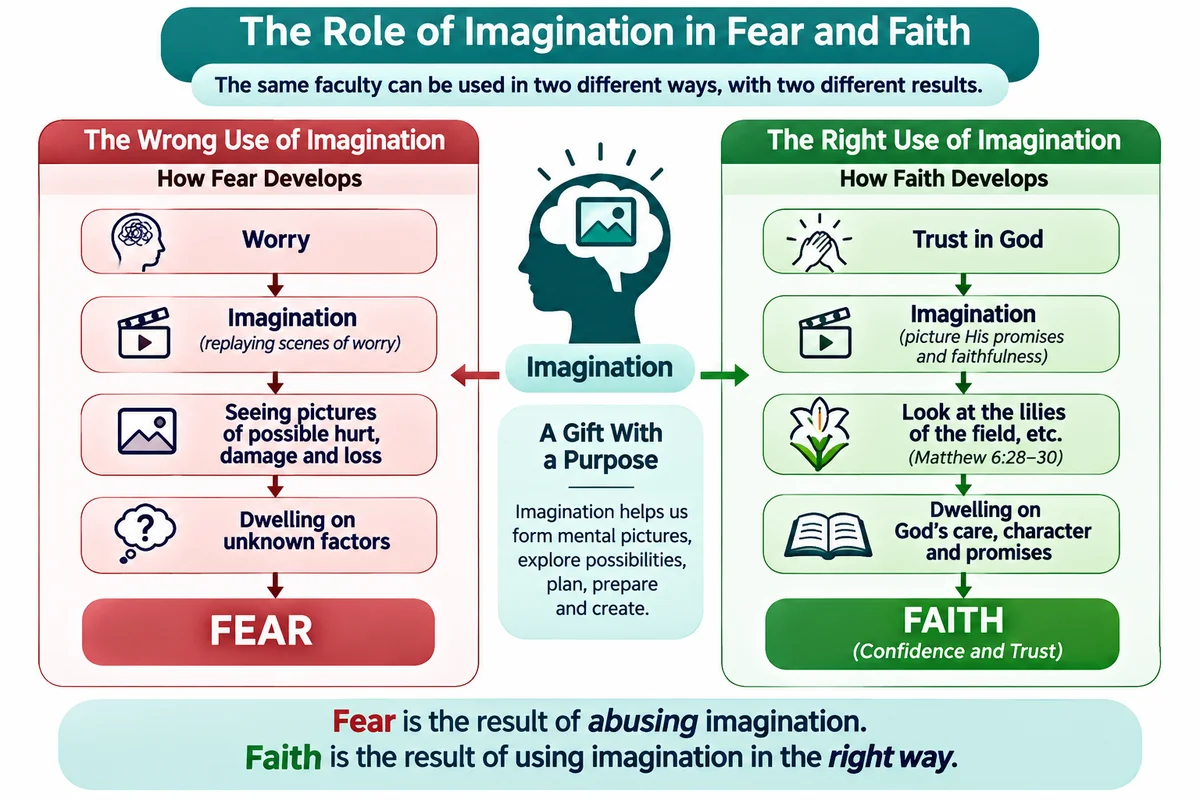
Let us consider what happens when we become worried about something. Suppose we are facing an uncertain situation. We do not know what will happen, how much damage it may cause, or what the consequences might be. Instead of examining the situation objectively, we begin imagining different possibilities. We replay the incident in our minds. We create pictures of what might happen. We imagine unpleasant conversations, possible losses, punishment, rejection, and suffering. We keep returning to these mental pictures. The more we dwell on them, the more possibilities we create. One imagined situation leads to another. Eventually, we begin responding emotionally to things that have not even happened. Our imagination has started producing pictures of worry.
Consider this progression:
Worry → Imagination → Replaying unpleasant scenes → Dwelling on unknown factors → Fear.
We are using our imagination to repeatedly picture possible danger, hurt, damage, and loss. Instead of helping us prepare for life, imagination begins making life appear more threatening than it actually is. This is what I would call the wrong use or abuse of imagination. We are using a faculty designed to help us visualize possibilities and create constructive outcomes to repeatedly visualize undesirable possibilities.
The result is fear.
The Right Use of Imagination: How Faith Develops
Now let us consider the other side. What happens when we use the same faculty differently? Instead of imagining everything that could go wrong, we begin reflecting on what God has promised: His character, His care, and His faithfulness. We begin creating mental pictures based on our trust in Him.
This is not pretending that difficulties do not exist. It is choosing not to allow possible difficulties to occupy our entire imagination. Consider the words of Jesus in Matthew 6:26: "Behold the fowls of the air: for they sow not, neither do they reap, nor gather into barns; yet your heavenly Father feedeth them." Jesus directs our attention towards something we can observe in nature. He then says in Matthew 6:28, "Consider the lilies of the field and how they grow." Why does Jesus ask us to look at the birds and consider the lilies? He is teaching us to recognize God's care through what He has created. The birds do not live by worrying about tomorrow. The lilies do not struggle to manufacture their beauty. Yet God provides for them. Jesus uses these illustrations to help us understand that we have a heavenly Father who knows our needs. Now imagine using your imagination to dwell upon these truths. Instead of repeatedly picturing possible punishment, you picture God's willingness to forgive. Instead of imagining abandonment, you reflect on His promise never to forsake you. Instead of imagining every possible disaster, you remember His faithfulness in the past. Instead of allowing uncertainty to dominate your thoughts, you direct your attention towards the character of the One in whom you have placed your trust.
Consider this progression:
Trust in God → Imagination → Pictures of His faithfulness → Dwelling on His promises → Faith and confidence.
The same faculty that can strengthen fear can also be directed towards strengthening faith.
What Are We Feeding Our Imagination?
There is an important question we need to ask ourselves: What are we continuously feeding our imagination? Are we repeatedly picturing what might go wrong, or are we reflecting upon what God has promised? Are we rehearsing scenes of possible hurt and loss, or are we remembering His goodness and faithfulness? Are we allowing unknown factors to occupy our minds, or are we developing a better understanding of the One who knows everything? Our imagination does not operate in isolation. What we repeatedly think about and mentally rehearse can influence our feelings, expectations, and behavior. If we repeatedly picture danger, we may become increasingly apprehensive. If we deliberately direct our attention towards God's character and promises, we can develop greater confidence and trust. This requires conscious effort.
We cannot spend all our time imagining the worst possible outcomes and expect to remain emotionally peaceful. Similarly, we cannot expect our faith to grow if we never give our minds an opportunity to reflect upon God's goodness.
Faith Does Not Mean Ignoring Reality
There is one important distinction we must make. Using imagination correctly does not mean denying reality, ignoring genuine dangers, or refusing to prepare for difficulties. Faith is not pretending that nothing unpleasant can happen. A person can acknowledge a problem, consider its possible consequences, and take appropriate action without allowing worry to dominate his life. Faith means that uncertainty does not have to become our master. We may not know what tomorrow will bring, but we can know the character of the God who holds tomorrow. We may not know how a particular situation will develop, but we can trust that God will not abandon us. Our confidence is not based on knowing every possible outcome. It is based on knowing the One in whom we trust.
Conclusion: Use Imagination for the Purpose It Was Given
God has given us imagination as a valuable faculty. Like every other gift, it can be used constructively or destructively. We can use it to repeatedly create pictures of possible danger, punishment, hurt, and loss. When we do this, we feed worry and give fear more room to grow. Or we can use it to reflect upon God's promises, His character, His goodness, and His faithfulness. We can direct our thoughts towards reasons to trust Him rather than continuously rehearsing reasons to be afraid. The choice of what we dwell upon matters.
Remember:
Fear is the result of abusing imagination. Faith is developed when we use imagination in the right way, directing our thoughts towards God and the reasons we have to trust Him.
Do not allow the imagination God gave you to become a source of unnecessary fear. Learn to use it for the purpose it was intended: to help you see possibilities, envision what is good, and strengthen your confidence in God.